Benadryl Dosage Chart for Dogs by Weight
The short answer
Give about 1 mg of Benadryl per pound of body weight every 8 to 12 hours. That sits inside the 2 to 4 mg/kg dose in the Merck Veterinary Manual. A 25 lb dog gets 1 tablet of 25 mg. Use plain diphenhydramine only, and ask your vet first if your dog has a health condition or takes other medicines. You can work out the exact dose for your dog's weight in the Benadryl calculator.
Benadryl Dosage Chart for Dogs (lbs and kg)
Each row starts at 1 mg per pound and shows the 2 to 4 mg/kg veterinary range beside it. Tablet counts are whole or half tablets that land inside that range. Where none does, the cell says to use liquid. Give doses every 8 to 12 hours, never closer than 8 hours apart.
| Weight (lbs) | Weight (kg) | Dose range (mg, 2 to 4 mg/kg) | Starting dose (1 mg/lb) | 25 mg tablets | 12.5 mg chewables | Children's liquid (mL) |
|---|---|---|---|---|---|---|
| 5 | 2.3 | 4.5 to 9.1 | 5 mg | Use liquid | half a chewable (6.25 mg) | 2.0 mL |
| 10 | 4.5 | 9.1 to 18.1 | 10 mg | half a tablet (12.5 mg) | 1 chewable (12.5 mg) | 4.0 mL |
| 15 | 6.8 | 13.6 to 27.2 | 15 mg | 1 tablet (25 mg) | 1 1/2 chewables (18.75 mg) | 6.0 mL |
| 20 | 9.1 | 18.1 to 36.3 | 20 mg | 1 tablet (25 mg) | 1 1/2 chewables (18.75 mg) | 8.0 mL |
| 25 | 11.3 | 22.7 to 45.4 | 25 mg | 1 tablet (25 mg) | 2 chewables (25 mg) | 10.0 mL |
| 30 | 13.6 | 27.2 to 54.4 | 30 mg | 1 1/2 tablets (37.5 mg) | 2 1/2 chewables (31.25 mg) | 12.0 mL |
| 40 | 18.1 | 36.3 to 72.6 | 40 mg | 1 1/2 tablets (37.5 mg) | 3 chewables (37.5 mg) | 16.0 mL |
| 50 | 22.7 | 45.4 to 90.7 | 50 mg | 2 tablets (50 mg) | 4 chewables (50 mg) | 20.0 mL |
| 60 | 27.2 | 54.4 to 108.9 | 60 mg | 2 1/2 tablets (62.5 mg) | 5 chewables (62.5 mg) | 24.0 mL |
| 70 | 31.8 | 63.5 to 127 | 70 mg | 3 tablets (75 mg) | 5 1/2 chewables (68.75 mg) | 28.0 mL |
| 80 | 36.3 | 72.6 to 145.2 | 80 mg | 3 tablets (75 mg) | 6 1/2 chewables (81.25 mg) | 32.0 mL |
| 90 | 40.8 | 81.6 to 163.3 | 90 mg | 3 1/2 tablets (87.5 mg) | 7 chewables (87.5 mg) | 36.0 mL |
| 100 | 45.4 | 90.7 to 181.4 | 100 mg | 4 tablets (100 mg) | 8 chewables (100 mg) | 40.0 mL |
Children's liquid is 12.5 mg per 5 mL (2.5 mg per mL). Plain diphenhydramine only.
Save or Print This Benadryl Dosage Chart
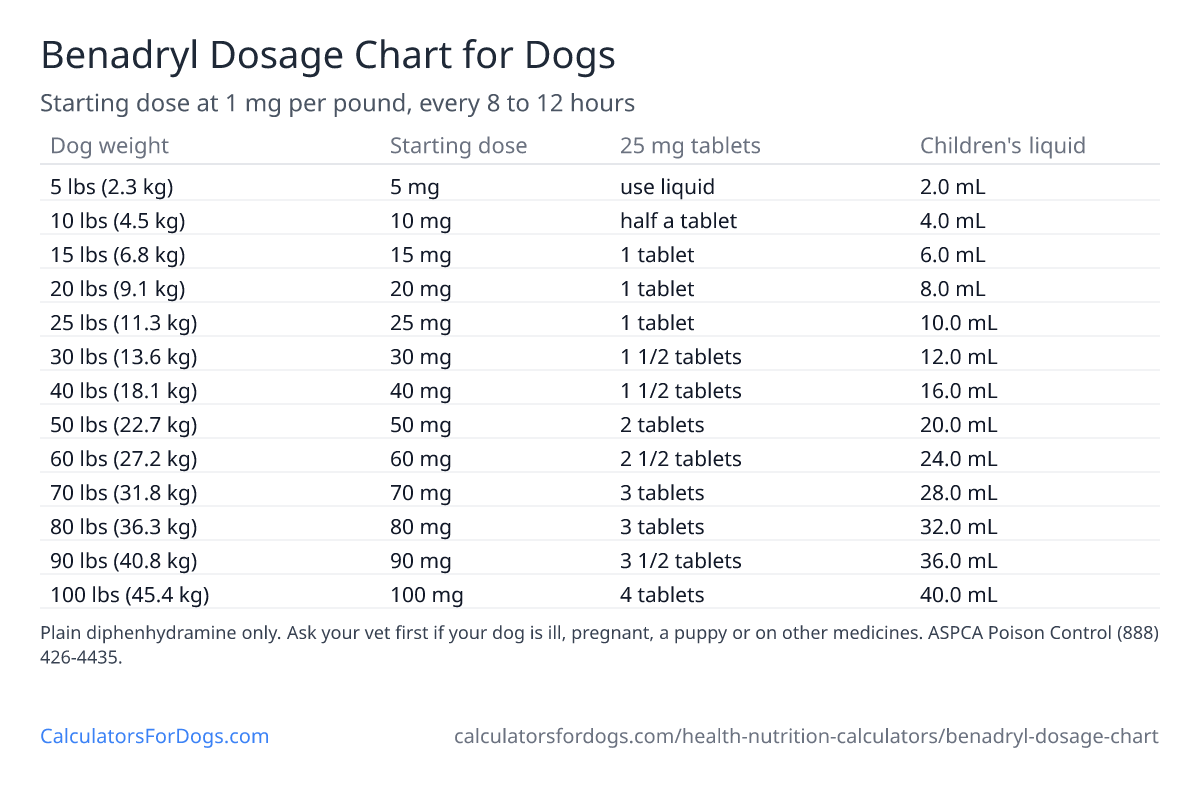
Right-click (or long-press) the image to save the chart. It shows the same starting doses as the table above, generated from the same dose math.
Diphenhydramine is not FDA-approved for dogs, and this page has not been reviewed by a veterinarian. Confirm any dose with your vet.
How Much Benadryl Can I Give My Dog?
The Merck Veterinary Manual lists diphenhydramine at 2 to 4 mg per kilogram, by mouth, every 8 to 12 hours as needed, and the Pet Poison Helpline gives the same 2 to 4 mg/kg as the normal dose for dogs. The veterinary product Vetadryl, which is diphenhydramine made for dogs and cats, carries the same range on its label: every 8 to 12 hours for allergies and every 8 hours for motion sickness.
Most owners find pounds easier, so the chart starts at 1 mg per pound. That is 2.2 mg/kg, inside the range and close to its low end. The range in pounds is about 0.9 to 1.8 mg per pound, so a dose above roughly 1.8 mg per pound is above the top of the veterinary range. Worked examples at 1 mg per pound:
- 10 lb (4.5 kg): 10 mg, which is 4.0 mL of children's liquid or half a tablet of 25 mg. The veterinary range is 9.1 to 18.1 mg per dose.
- 25 lb (11.3 kg): 25 mg, which is 10.0 mL of children's liquid or 1 tablet of 25 mg. The veterinary range is 22.7 to 45.4 mg per dose.
- 50 lb (22.7 kg): 50 mg, which is 20.0 mL of children's liquid or 2 tablets of 25 mg. The veterinary range is 45.4 to 90.7 mg per dose.
- 65 lb (29.5 kg): 65 mg, which is 26.0 mL of children's liquid or 2 1/2 tablets of 25 mg. The veterinary range is 59 to 117.9 mg per dose.
Tablets rarely match a dog's weight exactly. The chart only uses whole and half tablets, and only when the result stays inside 2 to 4 mg/kg. A 30 lb dog, for example, cannot be given 30 mg with 25 mg tablets: one tablet falls just below the range, so the chart gives one and a half. For dogs under about 6.9 lb, even half a 25 mg tablet is above 4 mg/kg, which is why very small dogs get a liquid volume or a children's chewable instead.
The Pet Poison Helpline warns against using a human label to work out a pet's dose. Human directions are written for people and say nothing about a 15 lb terrier. For a dose at your dog's exact weight, with the product you own, use the Benadryl dosage calculator for dogs.
Children's Benadryl for Dogs: Liquid and Chewables
Children's Benadryl liquid contains 12.5 mg of diphenhydramine in each 5 mL, which is 2.5 mg per mL (DailyMed label). At 1 mg per pound that is about 0.4 mL per pound of dog. A 10 lb dog's 10 mg dose is 4.0 mL, and a 20 lb dog's 20 mg dose is 8.0 mL. Measure it with an oral syringe, not a kitchen spoon. The box directions say to give a child a dose every 4 to 6 hours. Do not follow them for a dog, whose dose is every 8 to 12 hours.
Children's Benadryl chewables are 12.5 mg each. One chewable falls inside 2 to 4 mg/kg for dogs of about 6.9 to 13.8 lb, so they suit small dogs that a 25 mg tablet cannot serve. The label lists no xylitol.
Check three things on any children's product. First, the Drug Facts panel must list diphenhydramine HCl and nothing else: the children's Plus Congestion liquid adds phenylephrine (5 mg per 5 mL) and must not be given. Second, read the inactive ingredients for xylitol. Children's Benadryl liquid lists none and is labeled alcohol free, but xylitol turned up in a few single-use vial products, and it is dangerous to dogs. Third, skip nighttime sleep-aid liquids, whose labels can list alcohol.
Which Benadryl Is Safe for Dogs?
Only products whose single active ingredient is diphenhydramine. The common forms, from their FDA DailyMed labels:
- Benadryl Allergy tablets and Liqui-Gels: 25 mg each. Store-brand diphenhydramine 25 mg is the same drug.
- Benadryl Allergy Extra Strength: 50 mg each. Liquid-filled softgels cannot be split.
- Children's Benadryl chewables: 12.5 mg each. Useful for small dogs, and the label lists no xylitol.
- Children's Benadryl liquid: 12.5 mg per 5 mL, which is 2.5 mg per mL. It is labeled alcohol free and lists no xylitol.
Never give these, whatever the dose:
- Benadryl Allergy Plus Congestion, which adds 10 mg of phenylephrine per tablet (5 mg per 5 mL in the children's liquid), and any product with pseudoephedrine.
- PM and nighttime pain products such as Tylenol PM, Advil PM and Aleve PM, which combine diphenhydramine with acetaminophen, ibuprofen or naproxen. See the acetaminophen toxicity calculator and the ibuprofen toxicity calculator if your dog has swallowed one.
- Nighttime sleep-aid liquids such as ZzzQuil and several store brands, whose labels list alcohol.
Xylitol is rare in diphenhydramine liquids. It appeared in 3 of 319 diphenhydramine liquid labels we checked on DailyMed. It is so dangerous to dogs that reading the inactive ingredients is still worth the ten seconds. If you find it, do not use that product, and see the xylitol toxicity calculator if any was swallowed.
How Often Can I Give My Dog Benadryl?
Every 8 to 12 hours for allergies, and every 8 hours for motion sickness, according to the Merck Veterinary Manual. The shortest interval in any source we read is every 8 hours, so give no more than three doses in 24 hours and never space doses closer than 8 hours. For a 25 lb dog at 25 mg, that is a daily total of 50 mg twice a day or 75 mg three times a day.
No source sets a limit on the number of days, and none says daily use is fine. Itching or swelling that keeps returning needs a vet to find the cause, so ask your vet before giving it every day or for more than a few days in a row.
How Long Does Benadryl Take to Work in Dogs?
VCA Animal Hospitals says diphenhydramine takes effect in about 1 to 2 hours, and that this short-acting medicine should stop working within 24 hours. Its effects can last longer in dogs with liver or kidney disease. A small canine study found that only around 8% of an oral dose reached the bloodstream on average, with a half-life of about 5 hours and very large differences between individual dogs. That variability is one reason the same dose relaxes one dog and does little for another.
For a car journey, give it 1 to 2 hours before you leave. For a sting, give it as soon as you notice the swelling, then watch your dog closely for the next hour.
What Benadryl Can and Cannot Do for Dogs
- Itchy skin and allergies: modest at best. The 2015 international guideline on canine atopic dermatitis says oral antihistamines might give a small and limited benefit in some dogs, mostly when given before a flare. For a non-drowsy option, compare the Zyrtec (cetirizine) dosage calculator and the Claritin (loratadine) dosage calculator.
- Hives, mild swelling and stings: it can ease mild signs. It is not a treatment for anaphylaxis.
- Motion sickness: the Merck Veterinary Manual says antihistamines prevent motion sickness, cause sedation and reduce drooling, dosed every 8 hours. It names maropitant, an FDA-approved prescription drug, as the preferred treatment for dogs.
- Anxiety, storms and fireworks: not reliable. PetMD notes it is not typically effective for anxiety. If your dog dreads the Fourth of July or New Year's Eve fireworks, ask your vet well ahead about prescription options such as those covered by the trazodone dosage calculator.
- Mast cell tumors: vets sometimes use diphenhydramine around mast cell tumor treatment. That is a veterinary decision with its own dosing, not a home dose.
When Not to Give Benadryl
VCA Animal Hospitals says not to use diphenhydramine in dogs allergic to it or to similar antihistamines, or in pediatric or neonatal pets. It advises caution, which in practice means asking your vet first, in dogs with:
- glaucoma
- an enlarged prostate, or an intestinal or bladder obstruction
- chronic obstructive pulmonary disease (COPD)
- elevated thyroid hormone
- heart disease or high blood pressure
- pregnancy or lactation
- old age, and working dogs that need to stay alert
The Vetadryl label adds that its safety in breeding animals is unknown and that it should not be used in them. VCA also notes that its effects can last longer in dogs with liver or kidney disease. The health checklist in the Benadryl calculator covers each of these and turns the result into a vet-first caution when any is ticked.
Side Effects of Benadryl in Dogs
The side effects VCA lists are sleepiness or lethargy, dry mouth, urinary retention, vomiting, diarrhea and loss of appetite. Excitement instead of drowsiness is described mainly in cats. In the ASPCA Animal Poison Control Center's cases, signs were dose-related: lower doses tended to sedate, higher doses caused hyperactivity and seizures. Hyperactivity or depression, drooling, fast breathing and a fast heart rate were the most common signs reported, usually within an hour.
Benadryl Overdose in Dogs
No veterinary source publishes a safe-to-ignore threshold for dogs. The ASPCA describes the safety margin for this antihistamine group as relatively narrow, with adverse effects reported at or less than 1 mg/kg above therapeutic doses. Dogs also vary widely: one dog recovered after about 67 mg/kg with intensive treatment, while a published fatal case involved an estimated 111 mg/kg.
Signs of too much include agitation or heavy sedation, aggression, a fast or irregular heartbeat, high blood pressure, tremors, high body temperature, vomiting, seizures and slowed breathing. If you think your dog has had too much, call your vet or the Pet Poison Helpline on (855) 764-7661 ($89 per incident) or the ASPCA Animal Poison Control Center on (888) 426-4435 (a consultation fee may apply). Have the box and the time of the dose ready.
Drug Interactions
VCA advises caution when diphenhydramine is combined with other anticholinergic drugs, tricyclic antidepressants, or central nervous system depressants such as sedatives, anesthetics and pain medicines. The ASPCA adds that using a diphenhydramine cream on top of an oral dose can push blood levels into the toxic range. If your dog is booked for skin allergy testing, VCA says to stop diphenhydramine at least two weeks beforehand.
Benadryl for Puppies
Ask your vet first. VCA says not to use diphenhydramine in pediatric or neonatal pets, and no veterinary source we found gives a safe minimum age or weight. Figures such as "8 weeks" or "12 weeks" that circulate online are not sourced. Itching in a young puppy is often caused by fleas or mites, which an antihistamine will not fix.
Benadryl Cream on Dogs
VCA's guidance for topical diphenhydramine is to stop your dog licking or grooming the spot for at least 30 minutes after applying it, and not to use it on blistered or oozing skin. Do not combine a cream with an oral dose without asking your vet, for the reason in the drug interactions section above.
Anaphylaxis: When Benadryl Is Not Enough
VCA describes anaphylaxis as a medical emergency that needs immediate treatment with drugs such as epinephrine. A 2013 veterinary review of anaphylaxis in dogs and cats (Shmuel and Cortes) puts epinephrine first-line, and notes that antihistamines may ease minor signs such as hives and itching but have not been shown to reliably prevent an anaphylactic reaction. Rapidly spreading swelling of the face or throat, trouble breathing, vomiting, pale gums, weakness or collapse after a sting or a new food means going straight to an emergency vet. Do not wait to see whether Benadryl helps.
Related Calculators
Explore these related tools to get a complete picture of your dog's care:
Frequently Asked Questions
Can dogs have Benadryl?
Often, yes, with a vet-approved dose. The Merck Veterinary Manual lists diphenhydramine (the drug in Benadryl) at 2 to 4 mg per kilogram every 8 to 12 hours for dogs. It is used off-label, because it is not FDA-approved for dogs, and only plain diphenhydramine is safe. Ask your vet first if your dog is a puppy, pregnant, has a health condition such as glaucoma or heart disease, or takes other medicines.
How many mg is 5 mL of children's Benadryl?
12.5 mg. Children's Benadryl liquid contains 12.5 mg of diphenhydramine in each 5 mL, which is 2.5 mg per mL. At 1 mg per pound, that is about 0.4 mL per pound of dog, so a 10 lb dog's 10 mg dose is 4.0 mL, measured with an oral syringe.
How much Benadryl for a 25 lb dog?
About 25 mg, which is 1 tablet of 25 mg, every 8 to 12 hours. The full veterinary range for 25 lb (11.3 kg) is 22.7 to 45.4 mg per dose. As liquid, it is 10.0 mL.
How much Benadryl for a 50 lb dog?
About 50 mg, which is 2 tablets of 25 mg or one 50 mg Extra Strength tablet, every 8 to 12 hours. The veterinary range for 50 lb (22.7 kg) is 45.4 to 90.7 mg per dose.
How much Benadryl for a 65 lb dog?
The 1 mg per pound target is 65 mg. With 25 mg tablets, the closest practical dose inside the 2 to 4 mg/kg range is 2 1/2 tablets of 25 mg, every 8 to 12 hours. The range for 65 lb (29.5 kg) is 59 to 117.9 mg per dose.
Can I give my dog 25 mg of Benadryl?
One 25 mg tablet falls inside the 2 to 4 mg/kg range for dogs weighing about 13.8 to 27.6 lb. Smaller dogs need less, usually as children's liquid, and larger dogs usually need more than one tablet.
How quickly does Benadryl make a dog sleepy?
VCA Animal Hospitals says diphenhydramine takes effect in about 1 to 2 hours. Sleepiness or lethargy is the first side effect VCA lists. A small canine study found very large differences between individual dogs in how the drug is absorbed and cleared, so the same dose can make one dog drowsy and barely affect another.
Can Benadryl kill a dog?
In a large enough overdose, yes. A published case describes a fatal poisoning in an 18 kg dog that may have swallowed about 111 mg/kg. The ASPCA notes that the safety margin for this group of antihistamines is narrow. Overdose signs include agitation or heavy sedation, a fast heart rate, tremors, high body temperature and seizures. Call your vet or a poison line at once.
Can I give my dog human Benadryl?
Plain human Benadryl, whose only active ingredient is diphenhydramine HCl, is the same drug vets use, but the box directions are written for people. The Pet Poison Helpline warns against using a human label to work out a pet's dose, so dose by your dog's weight instead. Never give Benadryl Allergy Plus Congestion (it adds phenylephrine) or PM and nighttime products (they add acetaminophen, ibuprofen or naproxen).
Can I give my dog Benadryl every day?
No veterinary source we found sets a limit on the number of days, and none says daily use is fine. Itching or swelling that keeps coming back needs a vet to find the cause, so ask your vet before giving it every day or for more than a few days in a row.
How much liquid Benadryl can I give my dog?
At 1 mg per pound, children's liquid works out to about 0.4 mL per pound of dog (2.5 mg per mL). That is 4.0 mL for 10 lb, 8.0 mL for 20 lb and 10.0 mL for 25 lb, every 8 to 12 hours. Use an oral syringe, and check the label lists only diphenhydramine as the active ingredient and no xylitol.
Sources
- Merck Veterinary Manual: Antihistamine Dosages for Integumentary Disease in Animals
- Merck Veterinary Manual: Motion Sickness in Animals
- VCA Animal Hospitals: Diphenhydramine
- VCA Animal Hospitals: Diphenhydramine Topical
- VCA Animal Hospitals: Anaphylaxis in Dogs
- Pet Poison Helpline: Accidentally gave your dog a double dose of Benadryl
- ASPCA Animal Poison Control Center: Antihistamine toxicology brief (Murphy, 2001)
- Buchweitz et al. Fatal diphenhydramine poisoning in a dog. Can Vet J 2014
- Ehling, Baumer and Papich. Diphenhydramine pharmacokinetics in dogs. Vet Dermatol 2019
- Olivry et al. Treatment of canine atopic dermatitis: 2015 ICADA update. BMC Vet Res
- dvm360 journal scan: Shmuel and Cortes, anaphylaxis in dogs and cats (2013)
- DailyMed: Children's Benadryl Allergy liquid label
- DailyMed: Benadryl Allergy Plus Congestion label
- DailyMed: Vetadryl (veterinary diphenhydramine) label
Updated October 2026. This chart is an educational tool, has not been reviewed by a veterinarian, and does not replace an examination by your vet.