Dog Age Chart: Dog Years to Human Years by Size
Convert your dog's age to human years with our interactive chart. Size-specific, science-backed, and built on the modern epigenetic aging formula, not the outdated "× 7" myth.
Science source: Conversions blend the 2020 UCSD epigenetic clock study (Wang et al., Cell Systems) with AKC and AVMA size-adjusted aging guidelines based on veterinary mortality data.
| Dog Age | ||||
|---|---|---|---|---|
| 1 year | 15 | 15 | 15 | 15 |
| 2 years | 24 | 24 | 24 | 24 |
| 3 years | 28 | 29 | 30 | 31 |
| 4 years | 32 | 34 | 36 | 38 |
| 5 years | 36 | 39 | 42 | 45 |
| 6 years | 40 | 44 | 48 | 52 |
| 7 years | 44 | 49 | 54 | 59 |
| 8 years | 48 | 54 | 60 | 66 |
| 9 years | 52 | 59 | 66 | 73 |
| 10 years | 56 | 64 | 72 | 80 |
| 11 years | 60 | 69 | 78 | 87 |
| 12 years | 64 | 74 | 84 | 94 |
| 13 years | 68 | 79 | 90 | 101 |
| 14 years | 72 | 84 | 96 | 108 |
| 15 years | 76 | 89 | 102 | 115 |
| 16 years | 80 | 94 | 108 | 122 |
| 17 years | 84 | 99 | 114 | 129 |
| 18 years | 88 | 104 | 120 | 136 |
| 19 years | 92 | 109 | 126 | 143 |
| 20 years | 96 | 114 | 132 | 150 |
Puppy Age in Human Years (First Year)
| Puppy Age | Human-Equivalent |
|---|---|
| 2 months | 14 months |
| 3 months | 3 years |
| 6 months | 9 years |
| 9 months | 12 years |
| 12 months | 15 years |
Save or Print This Dog Age Chart
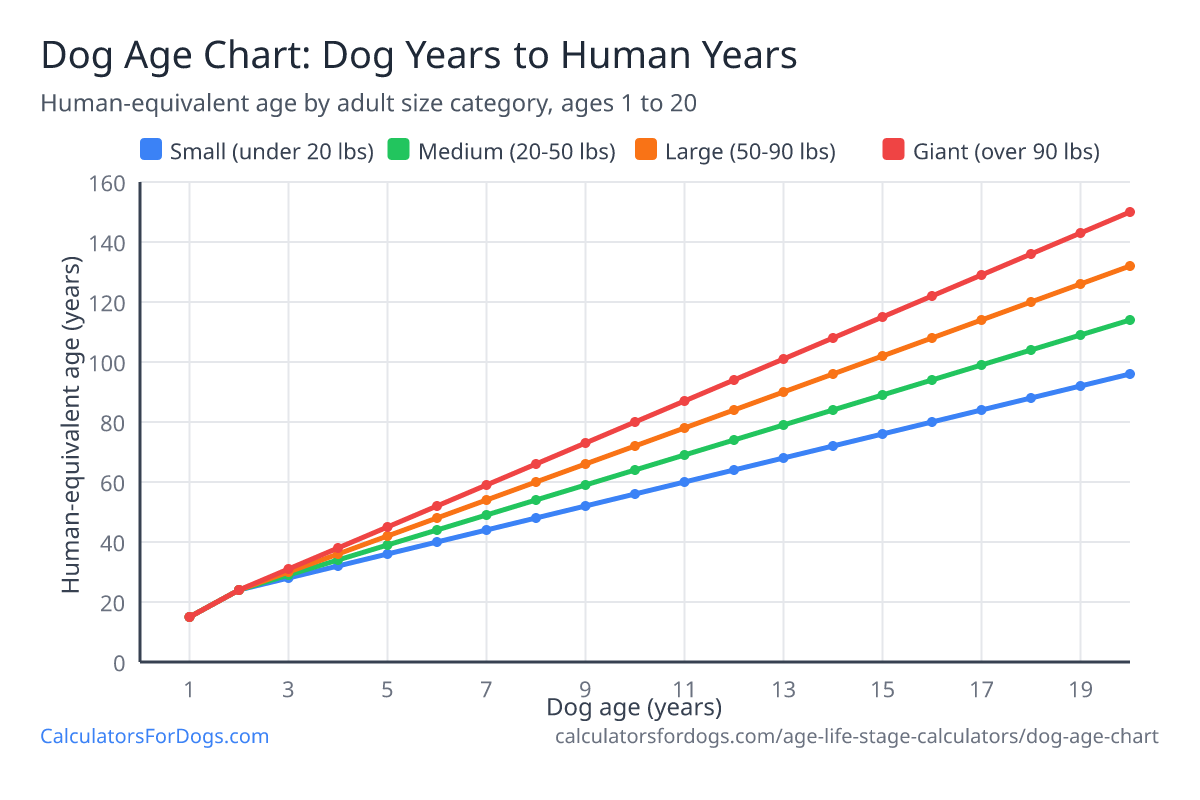
Want the dog years to human years chart on the fridge or on your phone? Right-click (or long-press) the image below to save the full-size version, or print this page. It shows the same size-adjusted conversions as the table above, ages 1 to 20, for small, medium, large and giant breeds.
What is a Dog Age Chart?
A dog age chart converts a dog's chronological age into the equivalent human age, helping owners understand their pet's life stage, physical development, and care needs. Modern dog age charts replace the outdated "multiply by 7" rule with size-adjusted curves that reflect how fast different dog breeds actually age. The interactive chart above shows ages 1-20 mapped to human equivalents for small, medium, large, and giant breeds, plus a special table for puppy months.
Why does size matter so much? Because aging in dogs is non-linear. All dogs hit roughly the same developmental milestones in year one (puberty, near-full body size), but after that, smaller dogs slow down while larger dogs continue at an accelerated cellular pace. A 10-year-old Yorkie may have the energy of a 50-year-old human, while a 10-year-old Great Dane is closer to 80.
The Myth of "1 Dog Year = 7 Human Years"
The classic 7:1 ratio dates to the 1950s and was likely derived from a rough comparison of average human lifespan (70 years) to average dog lifespan (10 years). It is convenient but biologically wrong. Dogs do not age uniformly. A 1-year-old puppy can reproduce, has nearly full adult bones, and shows the emotional maturity of a mid-teen human, equivalent to roughly 15 human years, not 7.
In 2020, a team of researchers at UC San Diego published a study in Cell Systems on DNA methylation, a chemical fingerprint of cellular age, in 104 Labrador Retrievers and humans. They found a logarithmic relationship: human_age = 16 × ln(dog_age) + 31. This formula confirmed that early dog years pack in dramatic biological aging, while later years slow considerably. The chart above extends this insight by layering size-based adjustments derived from large-scale veterinary mortality data.
How the Chart Calculates Dog Years
Our chart uses a three-stage formula validated against both epigenetic data and veterinary lifespan studies:
- Year 1: Every dog regardless of size reaches roughly 15 human-equivalent years. This covers rapid neurological and physical maturation, puberty, and most growth-plate closure.
- Year 2: Adds another 9 human years for a cumulative 24, reflecting the transition into full adulthood.
- Year 3 onward: Each additional dog year adds a size-dependent number of human years: Small (+4), Medium (+5), Large (+6), Giant (+7). This is where the curves diverge dramatically.
For example, a 6-year-old dog: small breed = 24 + (4 × 4) = 40 human years; giant breed = 24 + (7 × 4) = 52 human years. That 12-year gap reflects the real biological difference picked up by veterinary mortality records and epigenetic markers.
Why Size Matters: The Biology of Dog Aging
Large and giant breeds undergo extreme growth in their first 18-24 months, sometimes increasing body weight 100x from birth. This rapid growth is metabolically expensive: it generates oxidative stress, accumulates DNA damage, and burns through cell-division reserves. A 2013 study in The American Naturalist covering 74 breeds and 56,000+ dogs found large dogs die younger primarily because they age faster, not because of any single disease.
Skull shape (brachycephalic vs. dolichocephalic) also matters but secondarily. Among same-sized breeds, those with elongated noses tend to live slightly longer. The dog age chart above focuses on size because it explains 70-80% of the lifespan variance between breeds, according to the 2024 Scientific Reports study of 584,734 UK dogs.
Life Stage Milestones on the Chart
Knowing your dog's human-equivalent age helps you anticipate care transitions:
- Puppy (0-15 human years): Up to age 1 in dog years. Focus on socialization, vaccinations, growth-formula nutrition.
- Young Adult (15-30): Age 1-3. Peak energy, training consolidation, switch to adult diet.
- Adult (30-50): Age 3-7 for most sizes. Maintenance phase: weight, dental care, annual exams.
- Middle-Aged (50-60): Begin watching for early signs of arthritis, weight gain, dental disease. Add joint support.
- Senior (60-75): Twice-yearly vet visits, senior diet, baseline bloodwork. Giants enter this stage at age 6, smalls at age 10.
- Geriatric (75+): Cognitive support, mobility aids, quality-of-life monitoring. Many giant breeds reach this stage at age 8-9.
Related Calculators
Explore these related tools to get a complete picture of your dog's care:
Frequently Asked Questions
Basic Understanding
Is 1 dog year really equal to 7 human years?
No. The "× 7" rule is a myth from the 1950s. Modern research, including the 2020 UCSD epigenetic clock study, shows dogs age dramatically faster in their first two years (year 1 ≈ 15 human years, year 2 adds about 9 more), then slow down. After age 2, small breeds add about 4 human years per dog year, while giant breeds add 7 or more.
How do I read a dog age chart?
Find your dog's actual age in the leftmost column, then look across to the column matching your dog's adult weight category. The number is your dog's approximate equivalent human age. For mixed breeds, use adult weight, not breed.
How old is a 1-year-old puppy in human years?
A 1-year-old puppy of any size is roughly equivalent to a 15-year-old human. By age 1, most dogs have reached sexual maturity and finished most of their growth, mirroring the developmental milestones of a mid-teenager.
How-To Questions
How is a dog's human age calculated?
Modern veterinary formulas use three stages: year 1 of a dog's life equals about 15 human years, year 2 adds another 9 human years (≈ 24 total), and each additional year adds 4-7 human years depending on size. The 2020 epigenetic formula human_age = 16 × ln(dog_age) + 31 produces similar results for medium breeds.
How do I calculate dog years for a mixed breed?
Use your dog's adult weight rather than breed. A 35 lb mixed breed follows the "medium" column even if its ancestry is mixed. Weight is the strongest predictor of aging rate because it correlates with cellular growth rate.
At what age is a dog considered a senior?
Giant breeds are seniors around age 6 (≈ 50 human years), large breeds around age 7 (≈ 54), medium breeds around 9 (≈ 59), and small breeds around 10 (≈ 56). Smaller dogs reach senior status later because they age more slowly after age 2.
Comparison Questions
What's the human equivalent of a 10-year-old dog?
A 10-year-old small dog is about 56 human years, medium is about 64, large is about 72, and giant is roughly 80. Giant breeds at age 10 are already geriatric.
Why do small dogs live longer than large dogs?
Large dogs grow faster during puppyhood, generating more oxidative cellular stress and depleting DNA repair capacity earlier. A 2013 study in The American Naturalist found large breeds die more often from cancer, with significantly higher oxidative DNA damage measured in puppies.
What's the oldest age a dog can reach in human years?
The verified oldest dog, Bluey (an Australian Cattle Dog), lived 29 years and 5 months, equivalent to roughly 160+ human years. More commonly, the longest-lived small breeds reach 18-20 years, equivalent to 100-110 human years.
Technical & Research Questions
Where does the science behind the chart come from?
The chart blends the 2020 UCSD study by Wang et al. (Cell Systems) that mapped DNA methylation patterns between dogs and humans, and AKC/AVMA size-adjusted aging guidelines built on veterinary mortality data from the Royal Veterinary College VetCompass programme.
Should I feed my senior dog differently?
Yes. Senior dogs typically need fewer calories (10-20% reduction), more digestible protein, joint-supporting omega-3s, and antioxidants. See our Senior Dog Nutrition Calculator for size and age-specific recommendations.
How accurate is this dog age chart?
The chart represents the current consensus from veterinary epidemiology and epigenetic research, but individual dogs vary. Genetics, nutrition, dental care, weight, exercise, and spay/neuter status can shift biological age by 1-3 human-equivalent years either way.
What to Check Next
For more personalized aging insights, try these tools:
- Dog Age Calculator: Get a precise human-equivalent age using the latest scientific formula and your dog's breed.
- Dog Lifespan Chart by Breed & Size: Compare expected lifespans across 50+ breeds.
- Senior Care Timeline Calculator: Plan screenings and care milestones based on your dog's size and current age.
Understanding Your Dog's True Age
Knowing your dog's real human-equivalent age is more than a fun fact, it shapes nutrition, exercise, screening, and quality-of-life decisions. Use the chart as a quick reference, and pair it with our Dog Age Calculator for a breed-specific estimate. If your dog is entering the senior stage, our Quality of Life Calculator and Senior Dog Nutrition Calculator offer practical, vet-aligned guidance.