Puppy Weight Chart by Breed Size: Birth to 24 Months
Track your puppy's growth with our interactive weight chart. See expected weight by week and month for toy, small, medium, large, and giant breeds, based on veterinary growth curves.
This page is a reference chart organised by size class. If you want a prediction for one specific puppy, entered by breed, sex, current weight and age, use the puppy weight calculator instead. For a puppy of unknown parentage, the mixed breed weight estimator takes both parent breeds.
Reference: Growth percentages reflect AKC breed standards, the Waltham Growth Chart, and Royal Canin Puppy Growth research. Individual breeds may vary 10-15%.
| Age | Toy (Adult < 10 lbs) | Small (Adult 10-25 lbs) | Medium (Adult 25-50 lbs) | Large (Adult 50-90 lbs) | Giant (Adult > 90 lbs) |
|---|---|---|---|---|---|
| Birth | 0.2 lbs 3% adult | 0.4 lbs 2% adult | 0.6 lbs 1.5% adult | 0.7 lbs 1% adult | 1 lbs 0.8% adult |
| 4 weeks | 1 lbs 17% adult | 2.9 lbs 16% adult | 5.6 lbs 14% adult | 7.7 lbs 11% adult | 10.8 lbs 9% adult |
| 8 weeks | 1.8 lbs 30% adult | 4.9 lbs 27% adult | 8.8 lbs 22% adult | 12.6 lbs 18% adult | 16.8 lbs 14% adult |
| 3 months | 3 lbs 50% adult | 8.1 lbs 45% adult | 15.2 lbs 38% adult | 21 lbs 30% adult | 27.6 lbs 23% adult |
| 4 months | 3.6 lbs 60% adult | 9.9 lbs 55% adult | 18.8 lbs 47% adult | 26.6 lbs 38% adult | 36 lbs 30% adult |
| 5 months | 4.2 lbs 70% adult | 11.7 lbs 65% adult | 22.4 lbs 56% adult | 32.9 lbs 47% adult | 45.6 lbs 38% adult |
| 6 months | 4.8 lbs 80% adult | 13.5 lbs 75% adult | 26 lbs 65% adult | 38.5 lbs 55% adult | 54 lbs 45% adult |
| 7 months | 5.2 lbs 87% adult | 14.8 lbs 82% adult | 29.2 lbs 73% adult | 43.4 lbs 62% adult | 62.4 lbs 52% adult |
| 8 months | 5.5 lbs 92% adult | 15.8 lbs 88% adult | 32 lbs 80% adult | 49 lbs 70% adult | 69.6 lbs 58% adult |
| 9 months | 5.8 lbs 96% adult | 16.6 lbs 92% adult | 34.4 lbs 86% adult | 53.2 lbs 76% adult | 76.8 lbs 64% adult |
| 10 months | 5.9 lbs 98% adult | 17.1 lbs 95% adult | 36 lbs 90% adult | 57.4 lbs 82% adult | 84 lbs 70% adult |
| 12 months | 6 lbs 100% adult | 17.6 lbs 98% adult | 38 lbs 95% adult | 61.6 lbs 88% adult | 93.6 lbs 78% adult |
| 18 months | 6 lbs 100% adult | 18 lbs 100% adult | 40 lbs 100% adult | 66.5 lbs 95% adult | 105.6 lbs 88% adult |
| 24 months | 6 lbs 100% adult | 18 lbs 100% adult | 40 lbs 100% adult | 70 lbs 100% adult | 120 lbs 100% adult |
Representative Adult Weights Used
- Toy: 6 lbs
- Small: 18 lbs
- Medium: 40 lbs
- Large: 70 lbs
- Giant: 120 lbs
Scale formula: actual weight = (chart weight × your expected adult / representative adult).
Save or Print This Puppy Weight Chart
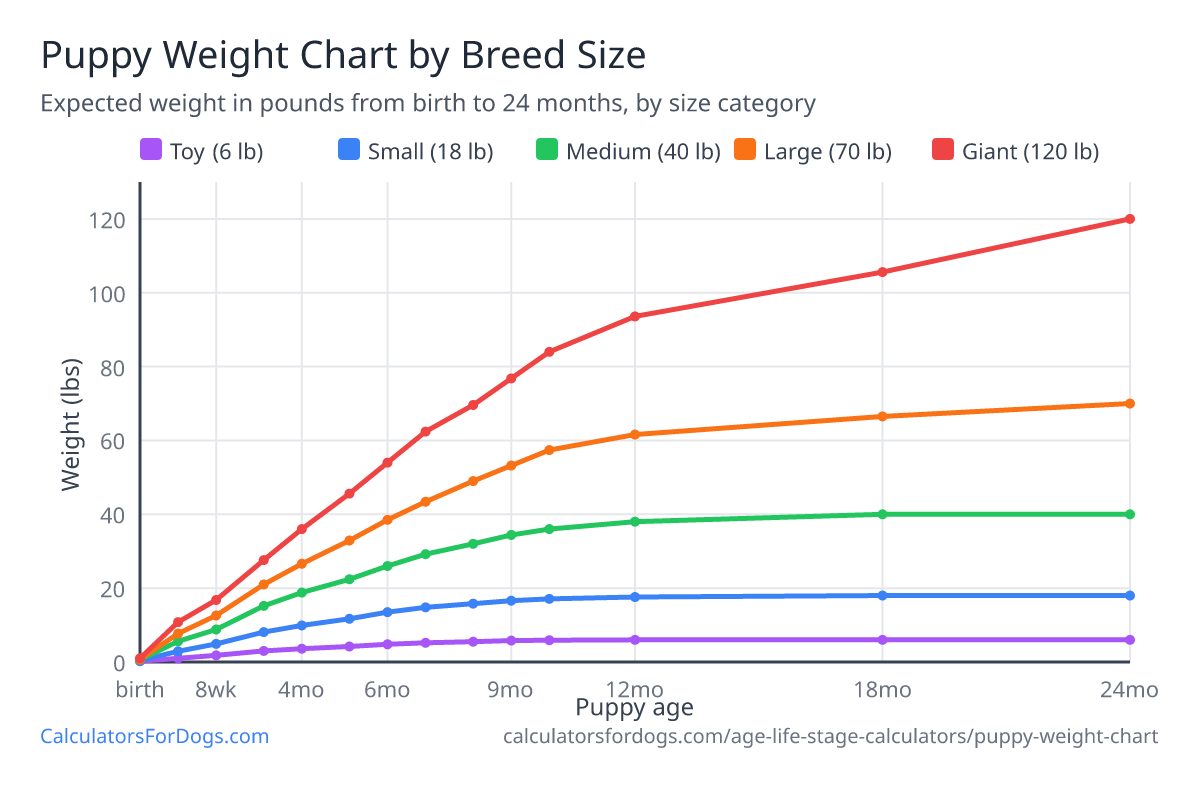
Tracking your puppy week by week is easier on paper. Right-click (or long-press) the image below to save the full-size puppy weight chart, or print this page and pencil in each weigh-in. It plots the same expected weights as the table above, birth to 24 months, for toy, small, medium, large and giant breeds.
What is a Puppy Weight Chart?
A puppy weight chart is a reference tool showing expected weight at each developmental milestone, broken out by breed size. Because growth rates vary enormously between a 6 lb Yorkie and a 120 lb Great Dane, a single "puppy growth curve" would be misleading. Instead, this chart shows five overlaid curves, one per size category, so owners can find their puppy's expected weight without doing math.
How Puppies Grow: The Five Size Categories
- Toy (adult under 10 lbs): Fastest curve. Reach 80% of adult weight by 6 months, full size by 9-10 months. Yorkies, Chihuahuas, Pomeranians, Maltese.
- Small (adult 10-25 lbs): Reach 75% by 6 months, full size by 9-12 months. Beagles, Cocker Spaniels, French Bulldogs.
- Medium (adult 25-50 lbs): Reach 65% by 6 months, full size by 12-15 months. Border Collies, Australian Shepherds, Bulldogs.
- Large (adult 50-90 lbs): Reach 55% by 6 months, full size by 15-18 months. Labs, Golden Retrievers, German Shepherds.
- Giant (adult over 90 lbs): Slowest curve. Reach 45% by 6 months, full size by 18-24 months. Great Danes, Saint Bernards, Mastiffs.
Why Large Breeds Grow So Slowly
Large and giant breeds grow more slowly because they have to grow more total mass safely. Bones, joints, ligaments, and tendons need time to develop strong enough to support eventual adult weight. Rapid early growth in these breeds is linked to osteochondrosis, hip dysplasia, panosteitis, and angular limb deformities. This is why large-breed puppy foods are formulated with lower calcium (0.7-1.2%) and lower energy density than small-breed puppy formulas.
How to Predict Adult Weight
Several rules of thumb work well alongside this chart:
- 14-week formula: weight at 14 weeks × 2.5 = adult weight (medium breeds).
- 6-month formula: Toy/small puppies × 2; medium × 1.5; large × 1.4; giant × 2.
- Parent average: For mixed breeds, take average of mother and father adult weights as initial estimate.
- DNA testing: Embark and Wisdom Panel provide breed mix-based adult weight predictions.
Feeding Your Puppy Through Growth
Calorie needs peak around 4-6 months when growth velocity is highest. Feed measured meals 3-4× daily until 6 months, then 2-3× until 12 months. Large and giant breeds should stay on specially formulated large-breed puppy food until 18-24 months. Body condition matters more than the scale alone, ribs should be felt but not seen, with a clear waist when viewed from above. Turn the adult weight above into today's portion size with the puppy feeding chart, which converts daily calories into cups of the exact food you are using, or check body shape against the body condition score calculator.
Related Calculators
Explore these related tools to get a complete picture of your dog's care:
Frequently Asked Questions
Basic Understanding
How much should a puppy weigh at each age?
At 8 weeks, a toy puppy weighs about 30% of its adult weight, a small breed 27%, medium 22%, large 18%, and giant 14%. By 6 months, toys are at 80%, smalls 75%, mediums 65%, larges 55%, and giants 45%. The chart above shows the full curve.
When do puppies stop growing?
Toy and small breeds finish growing around 9-12 months. Medium breeds reach adult size by 12-15 months. Large breeds finish around 15-18 months. Giant breeds keep growing until 18-24 months.
What is a normal weight gain rate for puppies?
Puppies typically gain 5-10% of their body weight daily during the first 6 weeks. After weaning, weekly gains slow but remain steady. Sudden plateaus, drops, or doubling rates beyond chart ranges warrant a vet check.
How-To Questions
How do I read this puppy weight chart?
First identify your puppy's size category based on expected adult weight (under 10 lbs = toy, 10-25 = small, 25-50 = medium, 50-90 = large, over 90 = giant). Then find your puppy's current age and read across.
How often should I weigh my puppy?
Weekly until 16 weeks, then every two weeks until 6 months, then monthly until they reach adult size. Use a kitchen or baby scale for puppies under 10 lbs.
How can I predict my puppy's adult weight?
A common method: weight at 14 weeks × 2.5 = adult weight for medium breeds. For toy/small breeds, double the 6-month weight. For large breeds, take the 6-month weight and add 50%.
Comparison Questions
Why do large breed puppies grow more slowly?
Large breeds grow over a longer period because their final size is much greater. Slower growth is biologically protective: it reduces the risk of orthopedic problems like hip dysplasia, osteochondrosis, and angular limb deformities.
When does a puppy reach half its adult weight?
Toy breeds hit 50% by about 13 weeks (3 months). Small breeds by 15 weeks. Medium breeds by about 19 weeks. Large breeds by 22 weeks. Giant breeds by 26-30 weeks.
Can I use this chart for mixed breed puppies?
Yes. Estimate your puppy's expected adult weight (vets and breed-ID DNA tests can help), then use the closest size column. Mixed breeds typically follow the curve of their largest parent breed.
Technical Questions
Is my puppy underweight or overweight?
A healthy puppy stays within ±10-15% of the chart range. Use the Body Condition Score Calculator as a visual companion: ribs should be felt but not visible, with a defined waist.
What should I feed my puppy to support healthy growth?
Choose a puppy food labeled for your size category. Large and giant breed puppy foods have lower calcium and calories to prevent rapid growth. Feed measured meals 3-4× daily until 6 months, then 2-3× until 12 months.
Where does the data in this chart come from?
The growth percentages reflect standard veterinary growth references including AKC breed standards, the Waltham Growth Chart, and Royal Canin Puppy Growth research.
What to Check Next
- Puppy Weight Predictor: Get a breed-specific adult weight prediction.
- Puppy Development Calculator: See behavior and milestone timelines alongside growth.
- Daily Calorie Calculator: Get age-appropriate portion sizes.
Track Growth Confidently
A puppy weight chart gives you peace of mind. Use this chart as your reference, then refine with our Puppy Weight Predictor for an adult weight estimate. Pair both with our Body Condition Score Calculator for the most complete picture of your growing puppy's health.